- calendar_today August 16, 2025
.
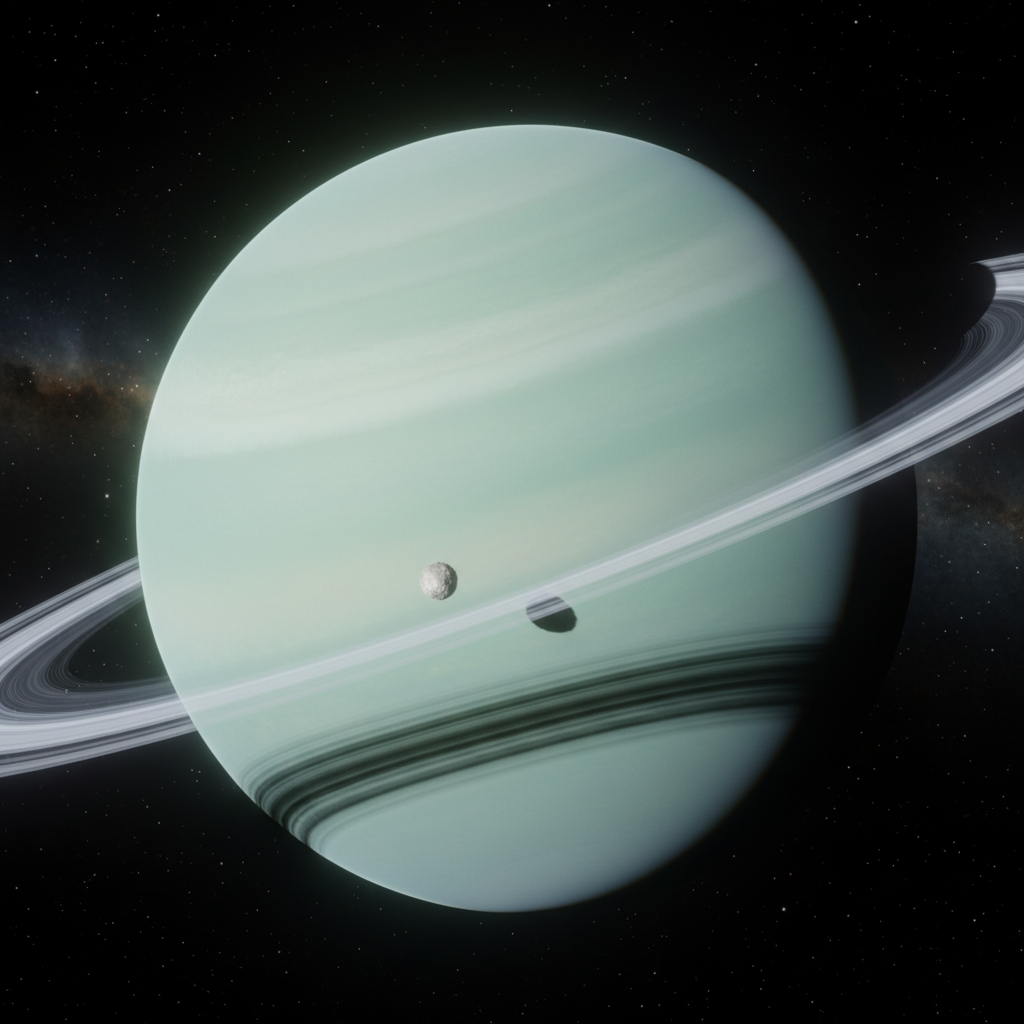
Astronomers using the James Webb Space Telescope (JWST) have discovered a new, as-yet-unnamed moon orbiting Uranus. The find is part of a NASA program dedicated to studying Uranus’ rings and inner moons. It brings the total known number of Uranian moons to 29, and the expectation is that more await discovery.
The diminutive object was revealed on February 2 as part of a search for faint natural satellites in the data from a set of long-exposure 40-minute exposures taken with Webb’s Near-Infrared Camera. The moon, which is only 6 miles (10 kilometers) in diameter, is one of the smallest Uranian satellites yet discovered. “The tiniest natural satellites have been so difficult to find because they are faint and they orbit so close to Uranus, which is itself very bright and easily outshines the moons,” said Maryame El Moutamid, an astronomer at the Southwest Research Institute’s Solar System Science and Exploration Division in Boulder, Colorado. “Even the NASA spacecraft Voyager 2 that famously flew by Uranus almost 40 years ago didn’t see it.”
El Moutamid is the principal investigator of a Webb program exploring the rings and inner moons of Uranus. “This is a small moon but a significant discovery because it shows how Webb is pushing our knowledge beyond that of any previous mission,” she said.
The new Uranian satellite, designated S/2025 U1, is about 35,000 miles (56,000 kilometers) from the center of Uranus. It orbits in the planet’s equatorial plane and has a nearly circular orbit between the moons Ophelia, just outside Uranus’ main ring system, and Bianca. Its orbit is also consistent with having formed in that general region.
To make the discovery, astronomers had to work hard to separate the satellite from Uranus’ bright glare and its rings. To do that, Webb had to use its infrared sensitivity to spot the faint glow from the tiny, dark moon moving in its orbit. Webb has already seen the rings and spied on the weather and atmosphere of Uranus, and this discovery extends the record.
The Discovery Opens Questions
The discovery of the new moon also raises new questions about the nature of Uranus’s ring system and how it came to be. The researchers think S/2025 U1 may have formed in the same event that produced parts of Uranus’ rings. “The discovery raises questions about how many more small moons remain hidden around Uranus and how they interact with its rings,” said El Moutamid.
In addition to five major moons, Uranus also has a group of smaller satellites. Miranda, Ariel, Umbriel, Titania, and Oberon are the five major moons, and the new find is the 14th small moon in the inner system. The blurred boundary between moons and rings
No other planet has so many small, inner moons so close together, and astronomers do not understand why. Their orbits are so close together that they could cross one another’s path, yet somehow they do not. They may even shepherd the narrow rings in that system.
“This is very exciting. It is a very faint, small satellite of Uranus that I was not involved with discovering, but know extremely well,” said Scott Sheppard, an astronomer at the Carnegie Institution for Science who co-discovered a Uranus moon in 2024, but was not involved in the new study. “The fact that this new object is so very close to Uranus’ inner ring system makes it very special, and it is only Webb’s exquisite sensitivity that has allowed for the detection of such small objects around the ice giant planets.”
Matthew Tiscareno, a co-principal investigator in the Webb Uranus program at the SETI Institute, said the detection of S/2025 U1 blurs the line even further. “Their complex inter-relationships also hint at a chaotic history, with many of these tiny moons even smaller and fainter than the previously known tiniest Uranian inner moons,” he said. “We expect even more remains to be discovered in these interior regions.”
Slowly Revealed
In the past, Uranus’ moons have been revealed a few at a time. Before Voyager 2’s historic flyby in 1986, only five moons (the biggest ones) had been seen, and the discoveries date back to 1787. Voyager 2’s pass by Uranus identified 10 more moons that orbited between 16 and 96 miles (26 and 154 kilometers) from the planet’s cloud tops. Telescopes on the ground and the Hubble Space Telescope found yet another 13 small moons in the 21st century. All these bodies are smaller than 8 to 10 miles (12 to 16 kilometers) across and are as dark as asphalt. By contrast, inner moons are thought to be made of ice and rock. The five big moons plus Oberon have the outer limit of what may have been captured asteroids.