- calendar_today August 12, 2025
.
Indian officials from the foreign minister to the prime minister visit Moscow as trade friction in steel and gas with the United States grows, and talks in Beijing focus on strategic ties.
In a relationship where India and the United States had been moving toward increased military-to-military, intelligence sharing, and coordination, where does all this leave that incredibly important relationship?
As ties between New Delhi and Washington sink to new lows over U.S. tariffs on steel and gas, oil sanctions have emerged as the most potent wedge in U.S.-India relations. The Trump administration’s tariff on Indian imports at 25 percent since June 16 in retaliation for New Delhi’s refusal to cut its purchase of Russian crude has led to calls for a reappraisal of ties. It’s expected to increase to 50 percent in a few weeks.
The mood in Indian diplomatic and defense circles “is that Delhi has been put in a very bad spot by the tariffs” and “that Washington has chosen sides,” said Ambassador Atul Keshap, who retired this year from the U.S. State Department after serving as consul general in the nation’s top trade consulate in Mumbai. “We have very, very capable professionals [here in India], but these are no longer policy conversations. Now they’re about commercial realities. Delhi’s first objective is now about managing the economic blowback from the tariffs.”
The Conversation Can’t Avoid Indo-Russian Economic Ties
It can’t be ignored. Moscow has been moving to build the production of shale gas through attracting foreign companies to production sharing agreements and using exports to Asia to keep prices low for European countries that have been stepping away from Russian gas.
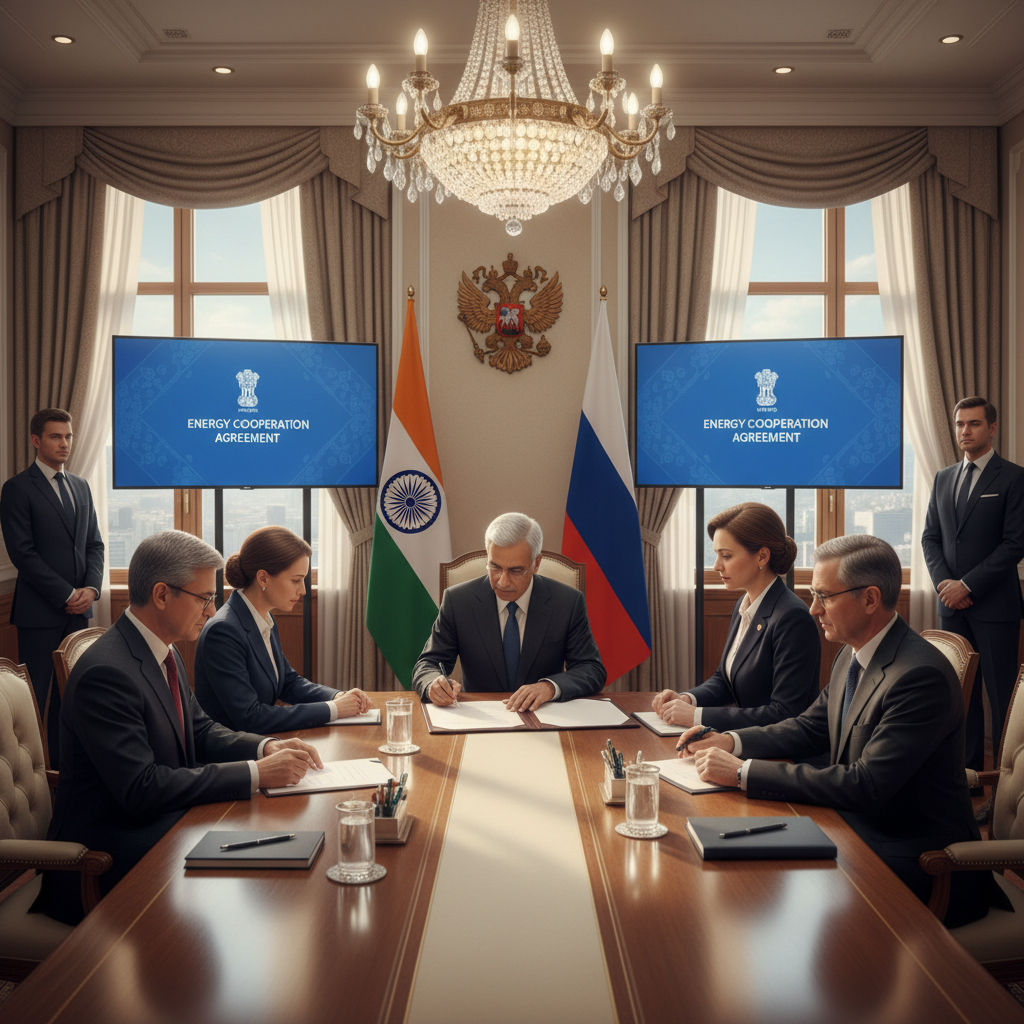
Last week, Russian President Vladimir Putin, on a state visit to India, signed agreements that would see Russian companies work in two of the world’s largest shale gas reserves. One is the Onge-Birbhum area in the state of West Bengal. The other is in the neighboring state of Jharkhand.
The development of these gas reserves has been a source of contention between New Delhi and Moscow. Russia’s Gazprom, in which the Indian government has a minority stake, had agreed to the development of Onge-Birbhum in April, but the agreement would need approval from the state government, which has been dragging its feet on the project. India also had said it would like to see more technology transfer on the project as part of any final deal.
Putin’s visit to New Delhi last week, in which he signed an agreement to set up a joint company to develop the Onge-Birbhum field in West Bengal, was seen as a sweetener to the growing friction over the gas sector.
On a visit to Beijing in May, Indian Prime Minister Narendra Modi sought to assure Chinese Premier Li Keqiang that the signing of the Russian deal was not about China but about getting better terms from Moscow. “India doesn’t want to see any damage to the relations between China and Russia,” Modi was quoted by the Press Trust of India news agency as telling Li.
Talks between Russia and India on the gas sector are ongoing, and Moscow has made clear that its priority is the continued development of the sector. Indian Oil Minister Dharmendra Pradhan visited Moscow last week to push for a settlement on Russian oil development in the two states.
With India already under pressure from Washington for its growing ties with Moscow, the U.S. State Department has been very clear in its support for Russian sanctions that have been imposed by the U.S. Congress on the gas sector.
“India is one of the main beneficiaries of U.S. sanctions against Russia,” said Karen Smith, a Russia analyst with the Foreign Policy Research Institute. “India has taken full advantage of the U.S. sanctions against Russia by stepping up its purchases of Russian gas, both in the form of direct imports and through the development of joint projects.”
“I think the main issue for India is how to best manage this new relationship with Moscow,” she added. “The big concern is that if Washington continues to apply pressure, then India may have no choice but to turn to China, which is not something that the United States would be happy with.”
In a column published last week in The Hindu, one of India’s most important daily newspapers, Raja Mohan, a well-known columnist and former Indian ambassador to China, wrote that it was time for New Delhi to “say enough is enough” to U.S. pressure over Russian gas. “The relationship with Russia is not an issue on which India should be pressurized by the United States, as it has been doing in recent weeks,” Mohan wrote.
China is also actively lobbying with Moscow to work with New Delhi. Beijing recently signed a major natural gas deal with Iran to work on developing gas fields in the South Pars field in the Persian Gulf.
India’s Oil Purchase from Russia
India imports around 18% of the crude oil from Russia, and Russian exports of crude oil to India will double in the current financial year, the Economic Times reported earlier this month, citing data released by the Ministry of Commerce.
India is also planning to invest in Russia’s vast energy resources, with a deal to build a refinery in Russia’s Far East. The plan is for India to spend $50 billion to build a refinery in the Sakhalin region of Russia that will process at least 50,000 barrels per day of crude, according to the Economic Times.
In March, Russia’s Rosneft and India’s Oil and Natural Gas Corporation announced they would invest $4.2 billion in the Far East oil refinery, which is scheduled to be operational by 2019.
Russia’s ONGC Videsh Limited has already invested in the refineries in the far-eastern parts of India, with the two sides in talks for further investment in Russia’s energy sector.