- calendar_today September 2, 2025
Apple may have discovered a new way to win President Donald Trump’s trade war: butter him up. On Wednesday, Trump announced Apple had been granted an exemption from a 100 percent tariff on semiconductors, a move that would have driven up the price of iPhones in all markets. The exemption, reported by Reuters, came in the same press briefing during which Apple announced a $100 billion investment in the U.S. and handed Trump a personalized statue.
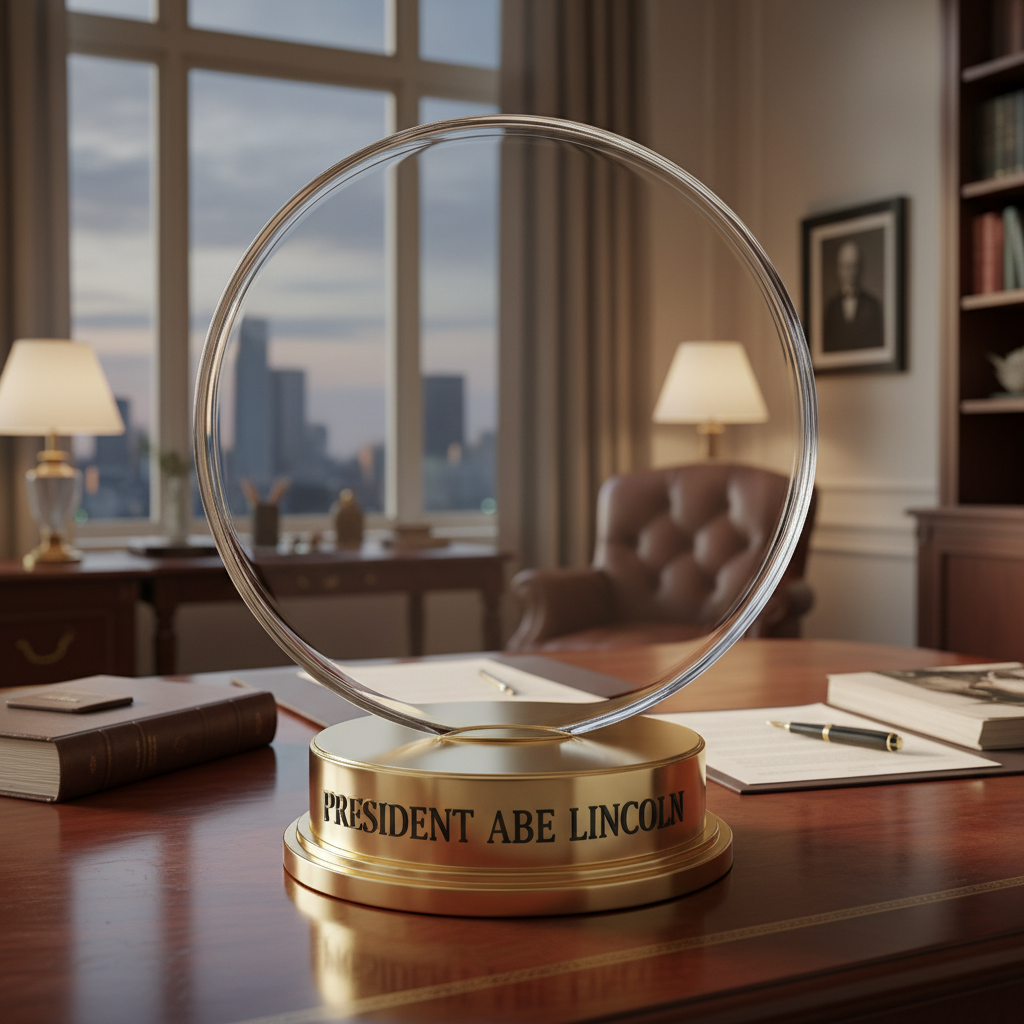
“The statue was designed by one of our former Marines, a corporal in the U.S. Marine Corps who now works for Apple,” CEO Tim Cook told reporters, describing how the artwork was made by Corning, a supplier that makes specialty glass for iPhones. The result is a large glass circle cut into the shape of a thick Apple logo. Cook added that the statue was a gift from Utah, and that “inside the glass is a 24 karat gold base with the president’s name engraved on it.” Cook then “added a personal note with a handwritten message on the statue that said, ‘Made in America,’” according to Reuters.
Trump, who has long demanded companies make more products in the U.S., seemed pleased with the symbolic gesture. Speaking from the Oval Office, where Cook presented the gift, Trump said Apple — as well as “any company that’s building a factory in this country” — would see “no charge” when tariffs on semiconductors go into effect. This is a major reprieve for Apple, which has been a target of Trump’s trade ire for months due to its supply chain remaining outside of the U.S.
In recent months, Trump has piled on after Apple shifted a small portion of iPhone production to India. In April, the president said he expected his trade war with China to result in “Made in America” iPhones. By May, the tone was sharper, and Trump said in the Middle East that he had “a little problem with Tim Cook” on the trade issue. Later, per reports, he told Cook: “We are treating you really good, we put up with all the plants you built in China for years. We are not interested in you building in India.”
Analysts have long warned that it’s not as simple as shifting iPhone assembly lines to the U.S., and that such a transition, if even possible, could take years. Trump’s team pushed the idea that this was feasible, and Commerce Secretary Howard Lutnick said Apple was even mulling “robotic arms” to make U.S.-made iPhones as precise as its Chinese plants.
Cook, in fact, has been beating back those claims and making assurances that Apple already does build components in the U.S. — such as semiconductors, glass, and Face ID modules. Cook gave no specific timeline for shifting final assembly to the U.S., however, and said it would be done “for a while” overseas.
Apple’s playbook in this area has been well-worn. During Trump’s last term, Cook managed to court the president through investment pledges while side-stepping his more direct demands. In 2017, Trump gushed that Apple would build three “big, beautiful” plants in the U.S. Only one opened, and it produced face masks. In 2019, Trump toured a Texas facility he claimed would produce iPhones. In fact, Apple had dedicated the plant to making MacBook Pros. In neither case did Apple shift iPhone production to the U.S.
Apple has since promised to spend $600 billion in the U.S. over the next four years. This would be a large sum in the abstract, but, as Reuters reports, analysts note that it tracks with Apple’s normal spending and the amounts pledged both to the Biden administration and Trump’s first term. In other words, Apple’s new pledge might be all talk.
Trump has said that any company not keeping its promise could be retroactively slapped with tariffs. But Apple seems content to proceed with its business plan as usual: building iPhones in Asia, while making some investments in the U.S. The tariff calculus has not changed, and Trump has opted not to make good on his threat.
Wall Street, for its part, has applauded Apple’s approach. Nancy Tengler, CEO and CIO of Apple shareholder Laffer Tengler Investments, told Reuters the company had “found a savvy solution to the president’s demand that Apple manufacture all iPhones in the U.S.”
Cook’s mixture of charm, a little bling, and some well-timed investments has bought Apple time in its war with Trump, just as it has in the past. Trump has said that he is making progress in terms of “Made in America,” but there’s no evidence that Apple’s most complex manufacturing jobs will move to the U.S., nor that the company will be punished for it.