- calendar_today August 15, 2025
Alien Motherhood and Aesthetic Horror in Species
A couple of weeks ago, Hollywood lost a movie icon. Michael Madsen, whose hardscrabble faces have peppered genre favorites like Reservoir Dogs, Kill Bill, and Donnie Brasco, was 79 when he died. While Madsen had legions of fan-favorite performances in his diverse filmography, it seems only right that we give a shout-out to one of his more unusual roles in this period. You may not remember Michael Madsen as a black ops mercenary taking down an interplanetary hybrid in the 1995 science-fiction creature-feature, Species. But now that the film turns 30 years old this year, we’ll cast a fond eye back at one of the forgotten sci-fi efforts of an era with just as many monster movies as alien paranoia.
Species starred Marg Helgenberger (CSI) and Michael Madsen, and was directed by Roger Donaldson (No Way Out, The Bounty). It was a strange mish-mash of sci-fi soft horror, with some larger-than-life action and a dash of hard science fiction all thrown into the mix. A year after the fall of the Soviet Union, a Soviet listening post picks up two transmissions from outer space. One is a document detailing a new fuel source that would make any energy company’s investors salivate. The other is a “perfectly calibrated” set of instructions on how to splice alien DNA with human DNA. Naturally, our government does as told. Under the benign (and very stoned) leadership of Dr. Xavier Fitch (Ben Kingsley), a cross-species experiment in gene-splicing yields one individual in particular.
Meet Sil, played by Michelle Williams in her infancy. The original intent of the project was to splice a docile, human-like lifeform that would be easier to study and manipulate. The results were not quite what Fitch had bargained for. Sil, the nickname given her by Dr. Fitch and his team, grows at twice the human rate, attaining the features of a 12-year-old girl in only three months. But something’s not quite right. She begins to have violent nightmares, and other signs begin to crop up to show her true nature, something Fitch and his team missed. Fitch, realizing his experiment may be uncontainable, orders cyanide gas to be pumped into her cell, and, in a short effort to stay alive, Sil breaks out and goes on her own.
Tracking her down is a team of specialists brought together by the need to eliminate Sil as a threat to the public. This includes Madsen’s Preston Lennox, a hard-boiled mercenary for hire; Dr. Laura Baker (Helgenberger), a molecular biologist; Dr. Stephen Arden (Alfred Molina), an anthropologist; and Dan Smithson (Forest Whitaker), a quiet empath who can sense Sil’s mood and emotional state. Tracking Sil from Maryland to Los Angeles, their mission is clear: capture and terminate. In LA, Sil is played by Natasha Henstridge and becomes all too intent on mating with a human and producing her offspring. She’s fast, smart, and knows how to adapt to her surroundings by any means necessary. The team races to stay one step ahead of her in a game of catch-and-kill, while a string of grisly bodies pile up from the nightclub scene and the train tracks to a ravaged apartment and a poisoned Fitch.
A Creature Built to Woo, and Murder
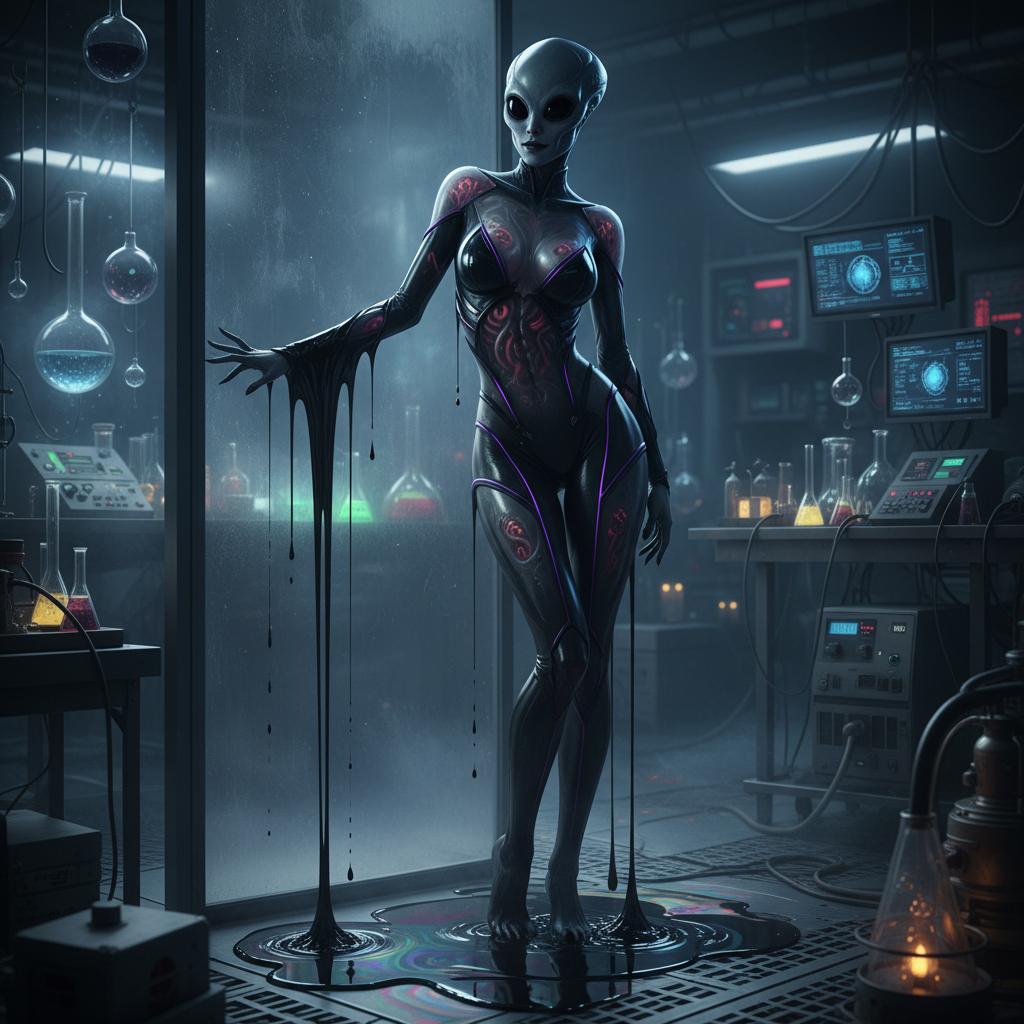
The species’ most significant and recognizable contribution was in the physical depiction of Sil herself. Done by legendary surrealist artist H.R. Giger, who famously designed the aliens of the Alien franchise, Sil was built to not only function as a killer, but also work as a multi-sensory seductress. Giger wanted “the monster as an aesthetic warrior, also sensual and deadly.” The work spoke for itself. Sil’s finished design in Species was a multi-stage process (but the end product, of a human woman with black fluid leaking through her flesh, translucent skin that was described as being like “a glass body but with carbon inside” remains one of the more memorable creature designs in all of cinema history.
Giger and his team did create a new breed of monster for the screen, one that was unique in the DNA-replicating process, unlike his earlier work in Alien. Giger would later claim that Species was in no way his “baby.” The film, he claimed, was a direct copy of his earlier Alien work, right down to the “punching tongue” and ending (Species involves Sil giving birth to an alien via a belly wound à la chestburster in Alien) that he felt was a far too direct a reference to Alien 3 (released the year prior) and Terminator 2 (the sequel his xenomorph was uncomfortably similar to). Giger would reportedly go on to call the studio and make them kill off Sil with a bullet to the head rather than engulf her with flame throwers during production, in a last-ditch effort to distinguish Species from other films.
Species was no masterpiece. Dialogue was clunky, characterization muddled, and the scientific themes beneath the surface (bioethics, motherhood, first contact) were all vaguely probed but left hanging in the end. Kingsley’s Fitch is a sociopath more than a villain, and Whitaker’s empath is too often relegated to the sidelines, shouting plot points. Marg Helgenberger is strong as the scientist toiling for the government without much enthusiasm, but Henstridge plays the hybrid a little too one-note in her full-grown state. The DNA-replicating aspect, while hardly a radical departure from the species-plants of sci-fi of the period, was just one piece of the narrative riddle here.
Screenwriter J.F. Lawton was influenced by an article written by Arthur C. Clarke some years prior, the argument of which proposed that the reason humanity has not made alien contact yet is because the speed of light is too fast a barrier for anything to be able to travel that great a distance and cross it in a reasonable time. If aliens can make contact with Earth, he said, they would have to do so in a unique way. And so the question arose: if faster-than-light travel is out of the question, what if alien life wanted to make contact with Earth and sent over not a robot but a set of blueprints for how to design and build an organic lifeform of its own instead?
Species doubles as a cautionary tale and an occasionally exhilarating B-movie throwback. It’s got the charisma to elevate it from straight-up throwaway and the spooky visual fidelity to make it linger in the mind for a few hours past its runtime. If not for its iconic tie-in figures and H.R. Giger-designed Sil, Species might have been cast off as just another summer offering in 1995. But it lives on thirty years later, not quite with the cache of Alien or The Terminator, but as a genre piece that did one thing remarkably well for its era.
A feature film score for Species will be released on vinyl and digital by La-La Land Records on September 29, 2023.