- calendar_today September 2, 2025
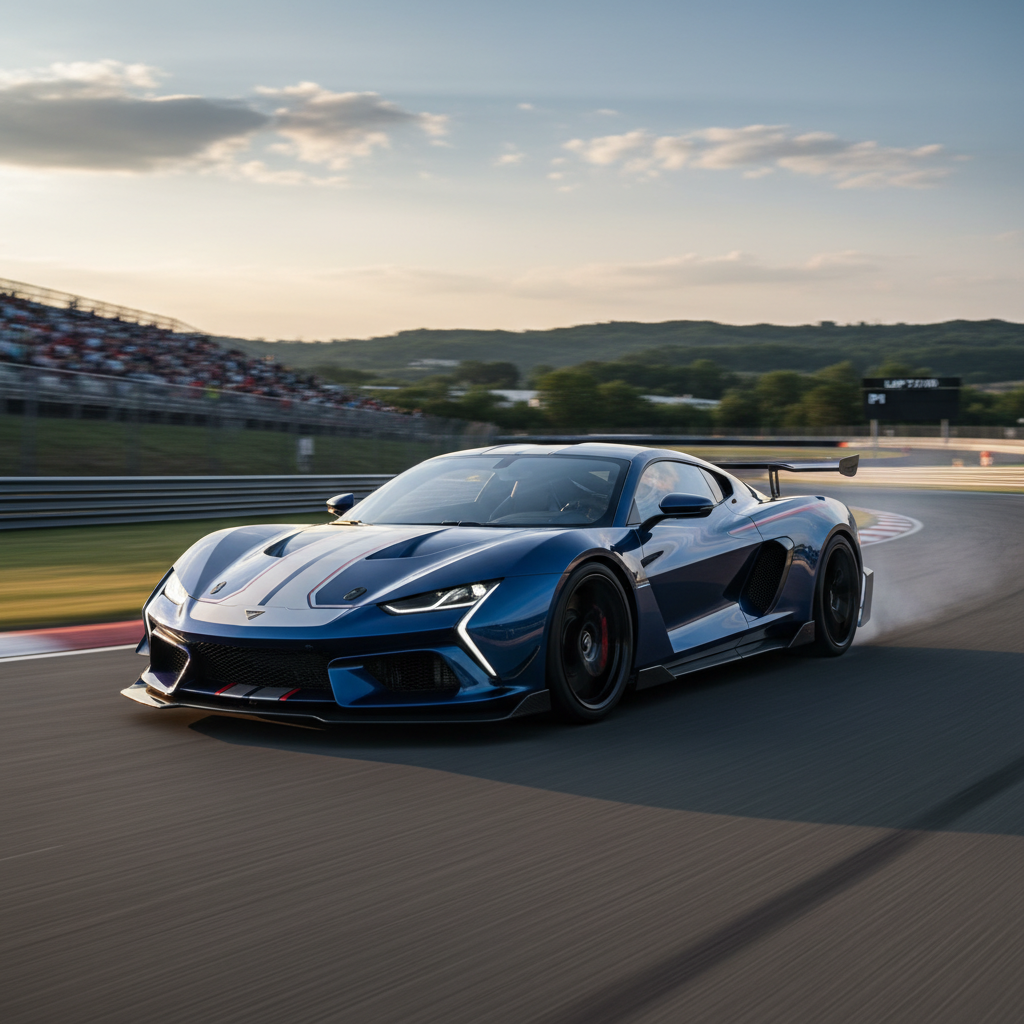
With its most recent concept, the ZR1X, Chevrolet is redefining what a Corvette can be. Declared during the official ZR1 launch, the ZR1X distinguishes itself not only as an improvement but also as a whole fresh approach for the American symbol.
With an all-wheel-drive hybrid powertrain and pushing a combined 1,250 horsepower, this Corvette aims for legendary rather than merely fast.
Power Triangles Tech in GM’s Greatest Corvette Still yet
Though that’s only half the story, the 1,064-hp twin-turbo V8 of the ZR1X is central. Now storing 26% more energy than the E-Ray unit, Chevy has added a front electric motor run-through a 1.9 kWh battery pack.
With its contribution of 186 hp and 145 lb-ft of torque, that front motor drives overall output to 1,250 hp (919 kW). Thanks to the traction advantages of all-wheel drive, all of this produces a projected 0–60 mph time under two seconds.
GM looked to Alcon for 16.5-inch carbon-ceramic brake rotors and its own first-ever 10-piston calipers to slow it down. Tested during a 60 mph drop from 180 mph at Nürburgring’s Tiergarten, these parts enabled the ZR1X to attain a startling 1.9 Gs of braking force.
The front axle of the ZR1X disengages quickly, same as the E-Ray, but now the threshold is set at 160 mph (257 km/h). With testing done using additional weight to replicate manufacturing trim, the car achieves the same top speed of 233 mph (375km/h) despite the additional hybrid equipment.
The ZR1X suffers most penalty from weight. In convertible form, it should tip the scales at about 5,000 pounds (2,268 kg), almost 500 pounds more than a Z51 Stingray. Still, Chevy says improved electronics and a better chassis let it pull one G of lateral and longitudinal acceleration at once.
Chevrolet had to deal with software flaws in the E-Ray including strange front-axle behavior and sensor failures under high acceleration. Tire flex during cornering distorted sensor readings, noted chief engineer Josh Holder. The control systems of the ZR1X were rebuilt in response for stability and accuracy at high loads.
Endurance, Qualifying, and Push to Pass are among the new suite of driving modes that let drivers customize the response of the car to any condition. For brief, high-impact performance surges, the Push to Pass feature grants complete access to the 1,250 hp of the car.
The ZR1X behaves differently than its forebears even under braking. To keep better chassis control, front axle regenerative braking is now timed with rear friction brakes.
Chevrolet also limits torque in first and second gear, not to slow down but rather to save the driveline. Holder says tires are already over their grip threshold at that power level.
Regarding EV range, not very much is expected. The ZR1X will probably cover just 3–5 miles (5–8 km) of all-electric range below 45 mph, much as the E-Ray. Here, domination rules rather than sustainability.
With the ZR1 starting at $174,995, pricing has not been formally revealed, but the ZR1X is looking to be among the most reasonably priced entries into the hypercar level.
Production for 2025 is scheduled; when it comes time, the ZR1X might very well mark a new golden era for American performance.