- calendar_today August 27, 2025
Artificial intelligence is no longer the catchphrase of technology—it’s a force already driving change, transforming industries, redefining work, and rebuilding the skills that count. In a World Economic Forum report for 2023, AI and automation are expected to disrupt nearly 50% of the world’s jobs by 2030. The news is creating shockwaves in the Sunshine State, where workers, teachers, and employers are coming together to prepare for a more dynamic future.
From Miami’s booming fintech industry to Orlando’s theme park operations and the manufacturing hubs of Tampa and Jacksonville, Florida’s workforce is facing a transformational decade. And while the potential for job displacement is real, so too is the opportunity for reinvention and growth.
AI in Florida’s Most Vulnerable Sectors
Florida’s diverse economy spans hospitality, healthcare, real estate, retail, and logistics. Unfortunately, many of these industries are ripe for automation:
- Hospitality and tourism, which employ a half-million Floridians, could see major disruption as hotels and theme parks introduce AI-based chatbots, facial recognition, and automated customer service.
- Retail jobs, from grocery clerks to cashiers, are being substituted or supplemented by smart checkout lanes and automated inventory control.
- Health care jobs, from radiology techs to administrative assistants, are being shaken up by AI-based diagnostics and automated scheduling systems.
- Even logistics and shipping—industries booming in hotspots like Jacksonville—are experiencing the nudge of automation via driverless trucks, route-smoothing software, and warehouse robots.
The Greater Demand for New Skills
As some people fear mass unemployment, experts point out that AI is not just about replacing jobs—it’s about changing them. A great deal of work today will be redirected, and workers will need to learn new skills in technology, data analysis, and digital communication.
Florida’s workforce is already adjusting.
“I’ve been a customer service rep for over ten years,” says Jasmine Lopez of Orlando. “I’m learning basic coding and analytics now so I can move into a more technologically savvy support role. It’s a question of keeping pace, not being left behind.”
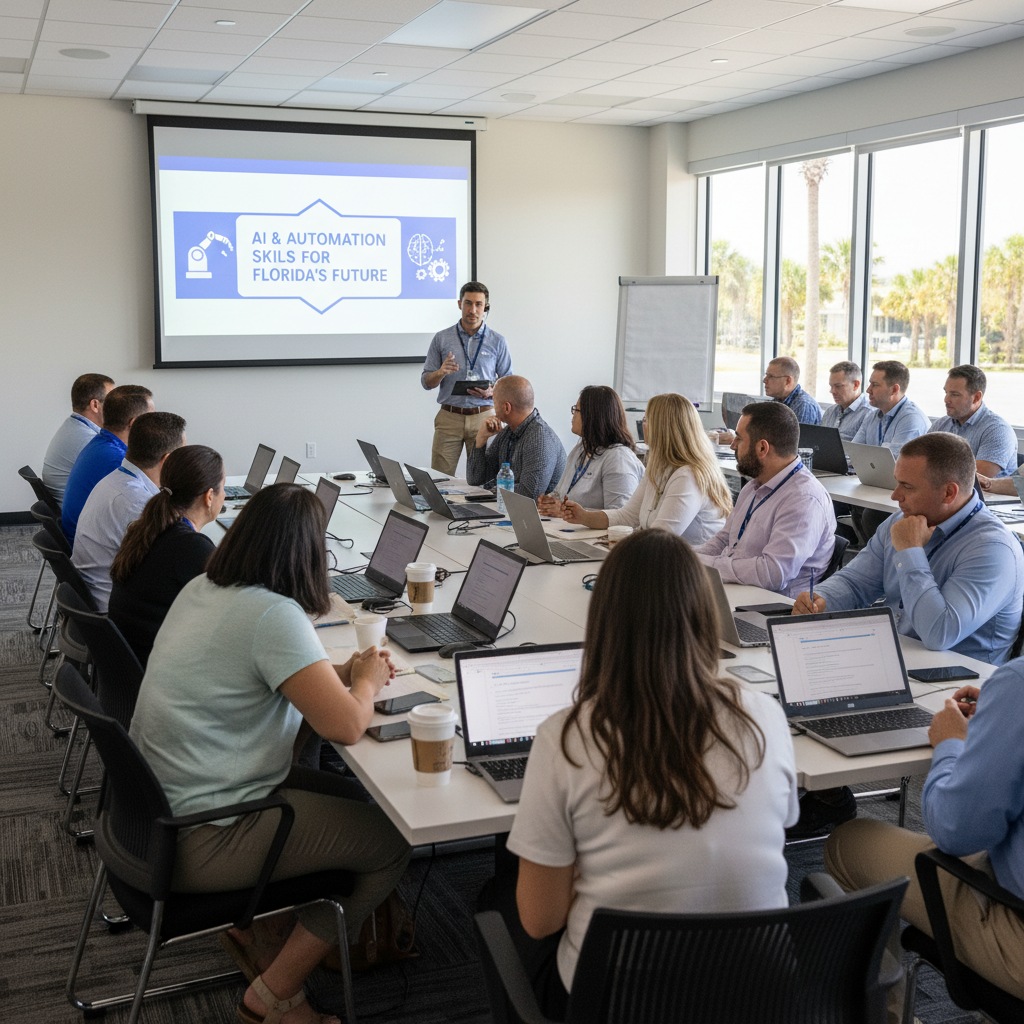
Local institutions like Miami Dade College, University of Florida, and Florida State University are stepping up by introducing more classes in AI-related fields like:
- Data science and analytics
- Cybersecurity
- Robotics
- Machine learning
- Human-computer interaction
These efforts are not just targeting recent high school graduates but also adults looking to reskill and remain relevant.
Public-Private Partnerships Take the Lead
The Florida government and the private sector are converging, sensing the urgency. Through grants and workforce development initiatives, the state is funding training programs and incentivizing companies to invest in AI training for employees.
The CareerSource Florida network—a statewide system of workforce development boards—is providing career guidance, retraining, and certifications aligned to the evolving job market.
In Tampa, a recent collaboration between local tech startups and the University of South Florida has led to an AI incubator focused on not only innovation but community education. The goal is simple: help Florida residents upskill before they get left behind.
AI’s Role in Florida’s Future Jobs
While certain jobs will vanish, lots of new ones will emerge. Economic analysts aver Florida has a good opportunity to generate new jobs in areas like AI incorporation, digital healthcare, green technology, and financial services—if it only plays its cards right.
Leading areas that are on the upswing include:
- AI system management
- Telemedicine support functions
- Computer programming and app development
- Data privacy and compliance
- Digital marketing and automation analytics
“There is no question that work will be changing,” says Dr. Peter Manning, a technology researcher at the University of Central Florida. “But strategic education and public investment can assist Florida in turning this challenge into a massive opportunity.”
Challenges Facing Vulnerable Populations
Not all Floridians are as ready for the AI revolution. Low-income workers, older adults, and limited-English proficient individuals typically have limited access to digital resources and technology skills. This creates a large digital divide with the potential to leave behind marginalized groups.
Organizations like Florida Literacy Coalition and Tech4Good Miami are stepping in to bridge this gap by offering free digital literacy classes, computer skills training, and device and internet access.
In rural northern and central Florida, the public libraries are evolving into learning centers where residents get to review technology training courses and get career guidance.
The Emotional Burden of an Uncertain Future
The evolution of AI also has an emotional cost. Career uncertainty, stress on learning new things, and job loss anxiety can impact one’s mental health.
I’ve worked in the tourist industry my whole life,” says Glenn Richards, a 52-year-old from Fort Lauderdale. “Now, I hear that AI can do half my job. It’s frightening. But I’m trying to concentrate on what I can control.”
Mental health practitioners encourage an anticipatory mind-set—becoming informed, becoming trained early, and connecting up with career advisors or peer networks—to deal more effectively with the transition.
Florida’s Path Forward
With the technology changing, Florida’s flexibility will be its best friend. The state’s resilience, diversified economy, and strong community networks are a solid platform for riding this technological transition.
Florida isn’t preparing for the loss of jobs. It’s preparing for the evolution of jobs.
Whether a staff member at an Orlando hotel is learning computerized reservation systems, a Miami marketer is learning about consumer behavior, or a Tampa factory worker is learning to operate robots, the thread is clear: change is near—and Floridians are getting ready.