- calendar_today August 14, 2025
.
Electric vehicles are in for a new round of skepticism in the US as buyers and charging challenges put the brakes on the fledgling industry. After more than a year of month-over-month sales increases, EV purchases are starting to decline. For now, at least, consumers are turning away from plug-in vehicles from Genesis and Volvo, and both automakers are reevaluating their lineups as a result.
Political headwinds have compounded the issue, with the Biden administration dialing back on vehicle pollution standards and eliminating subsidies to buyers. But according to new analysis from Telemetry, the single biggest challenge to US EV adoption may not come from policy but from existing household conditions.
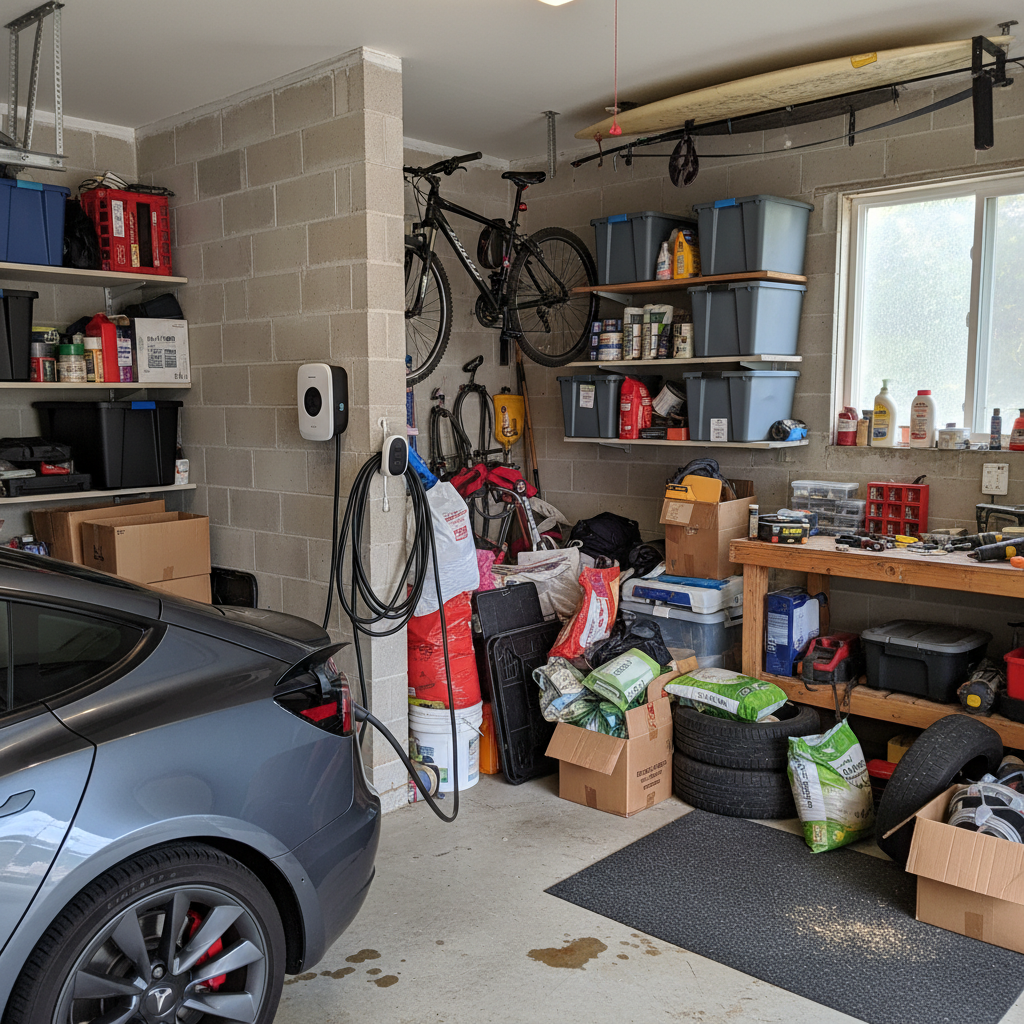
Consumer surveys have consistently shown that charging-related concerns are the biggest roadblock to EV purchase and adoption. A new report from Telemetry Vice President Sam Abuelsamid delves further into this anxiety, identifying one often-overlooked cause: garage clutter.
The recent buildout of fast-charging infrastructure has commanded much of the spotlight in recent years, but the majority of EV charging takes place at home. As much as 80 percent of all plug-in vehicle charging uses AC power, according to Telemetry, with a growing proportion of these chargers based at single-family residences. National Renewable Energy Laboratory (NREL) data shows that 42 percent of American homeowners already park their vehicles near a level 2 (240-volt) charger.
But more could park, and charge, if they reorganized their garages. That figure could jump to 68 percent with a simple change in parking behavior and home charging equipment, Abuelsamid estimates. “90 percent of all homes can have a 240 V outlet near where they could park a car,” he writes. “Parking behavior, namely whether homeowners use a private garage for parking versus storage, will likely be a key factor in EV adoption.”
If homeowners parked in their garages instead of using them for storage, the number of single-family homes with EV charging capacity could more than double, from 31 million to 54 million or more. This estimate includes homes where a new charger is already feasible, which could bring the number to more than 72 million. That total eclipses even Telemetry’s own optimistic estimate of EV market penetration by 2035, which they forecast at between 33 million and 57 million vehicles.
Potential capacity doesn’t mean actual capability, however. The same NREL study found that nearly 34 million homes would need expensive electrical upgrades to support the 30+ amps required by most level 2 chargers. This work, which could include rewiring the garage or a full panel replacement, could cost thousands of dollars for each home.
This discovery belies one of the primary selling points of EVs: long-term savings. When the cost of charger installation is factored in to purchase prices, the total cost of ownership could easily meet or even exceed that of a comparable gas-powered vehicle.
The situation only gets more complicated for the 23 percent of Americans living in multifamily housing, including apartment buildings, condos, and townhomes. For individual EV owners in these buildings, adding a charger is rarely possible, or desirable, due to their limited control over electricity in their buildings. Instead, they have to request approval from landlords, management companies, and co-op boards to charge in their parking space.
Those approvals may be slow to come, especially given the high cost of charger installation in existing buildings. Adding a pair of level 2 chargers to a co-op building may first require a multi-million dollar electrical panel upgrade. The wiring needed to reach distant parking spots only adds to that cost. Unlike in single-family dwellings, municipal or utility rebates are typically not available to building residents.
Today, only 1 in 10 of the 1 million EV owners living in multifamily homes park close enough to an outlet to charge. Some states are setting mandates that 20–25 percent of parking spaces in new construction will be EV-ready, but even those efforts will only lead to Telemetry estimating between 6.7 million and 11.4 million charging-capable spaces in all multifamily dwellings by 2035. That number may fall short of demand.
Given the limitations of home charging, public charging will be essential. Telemetry forecasts that between 11.7 million and 14.3 million EV drivers who live in single-family homes will still rely on public charging by 2035. An additional 7.8 million to 8.1 million EV owners in multifamily residences will also need public charging.
Facilitating all of that charging will take 523,000 to 586,000 DC fast chargers, plus an additional 1.5 million to 1.6 million level 2 chargers nationwide. Yet there are limits to that buildout as well, with power companies already stretched thin by demand from new AI data centers. That demand will only complicate generation and distribution upgrades required to install large public charging sites.
Despite years of optimism, it’s becoming increasingly clear that the U.S. EV revolution will not be smooth sailing. Millions of American homes have the potential to install EV chargers, but garage clutter, the high cost of electrical upgrades, and the difficulties of multifamily charging are just some of the obstacles likely to temper adoption in the coming years. Even with significant public charging expansion, demand may far outstrip supply by 2035.
For now, one thing is certain: the future of electric vehicles in America could be as much a function of homeowner garage space as automaker and government strategy.